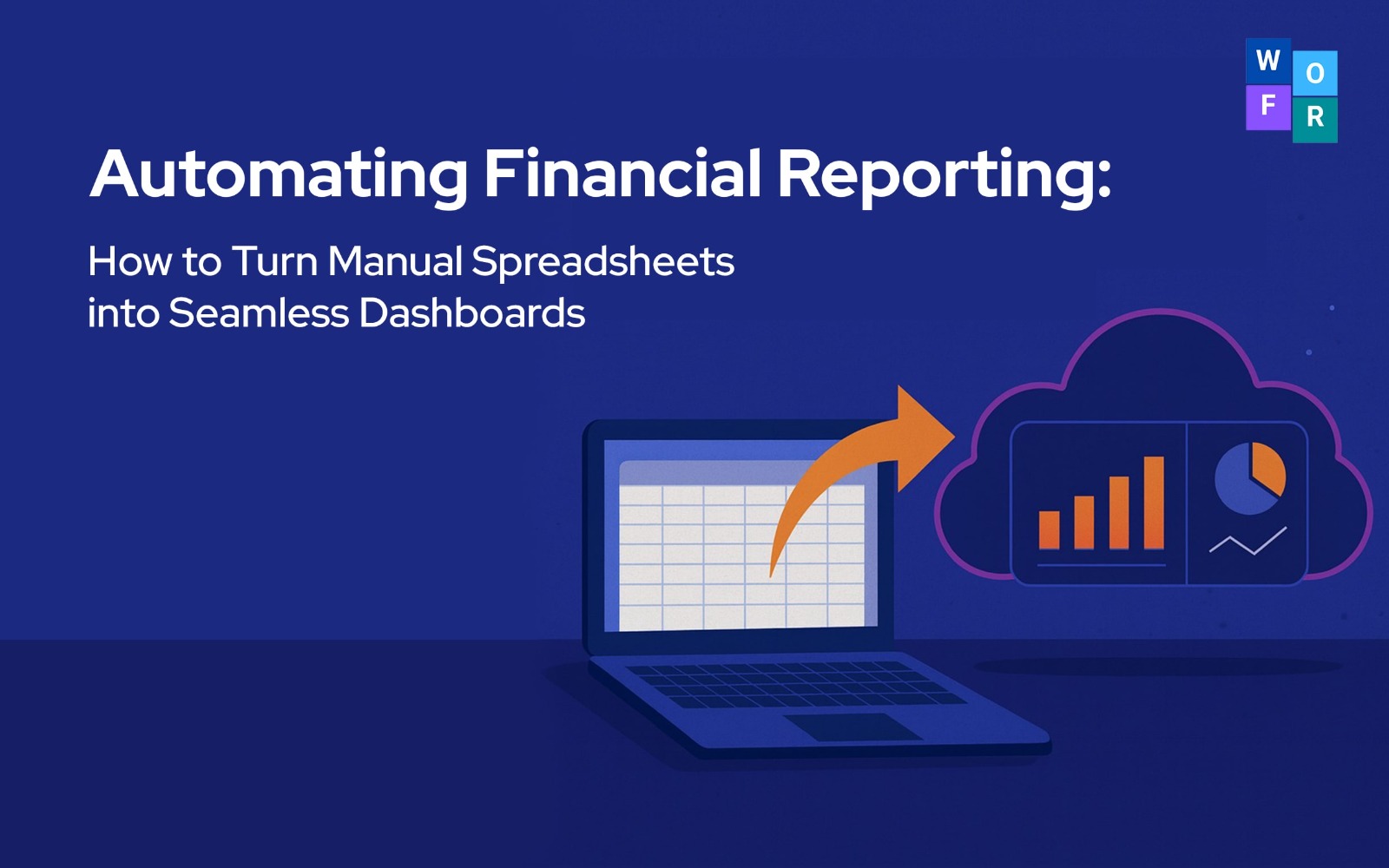
Spreadsheets were the workhorse of finance for decades. But today, relying on manual Excel files for monthly closing, reconciliations, and management reports creates risk, slows decision-making, and wastes valuable finance bandwidth. Automation and dashboards change that equation: they free your team from repetitive work, surface insights in real time, and deliver a single source of truth that leaders can drill down into, right to the underlying transaction!
At WOFR, we help organisations move from spreadsheet dependency to reliable, automated financial reporting. With experience across 200+ clients and 100,000+ hours, we combine our deep technical accounting knowledge with practical automation to deliver solutions that are accurate, timely, and actionable.
Why automate financial reporting now?
Speed: Automated data pipelines reduce month-end close time by eliminating manual data entry and reconciliation.
Accuracy: Fewer manual touches equals fewer errors and more reliable accounting books.
Visibility: Dashboards provide real-time KPIs for CFOs and business leaders, not stale numbers weeks after month-end.
Traceability: Automation creates consistent data flows and lets users drill down from a dashboard metric to the source document or transaction.
Scalability: As transactions grow, your reporting stays consistent without linear headcount increases.

The practical roadmap: 4 practices to move from spreadsheets to dashboards
- Take inventory: map data sources and owner responsibilities
Start by documenting where financial data lives today: ERP, payroll systems, bank statements, lease platforms, spreadsheets, CRM, and third-party vendors. For each source, note the data owner, refresh frequency, and quality issues. This creates the blueprint for automation.
- Define the reporting universe and KPIs
Agree on the key reports and metrics the business needs: P&L by segment, cash flow, working capital, revenue drivers, lease exposure, KPI dashboards for sales and margins. Be pragmatic: start with the 8-12 high-value dashboards, not 50 niche reports.
- Automate reconciliations and controls
Automate bank imports, AR/AP reconciliations, and matching routines (PO → GRN → Invoice). Route exceptions to owners with SLA tracking. Implement audit trails so every automated journal has supporting evidence attached. These controls reduce audit queries and make the close predictable.
- Pilot, iterate, and scale
Start with a pilot – one business unit or key report. Validate numbers against manual reconciliations, collect stakeholder feedback, and iterate. Once stable, scale across the organisation and add automation for adjacent processes like lease accounting, fund NAV calculations, or MIS reporting.
Common pitfalls and how to avoid them
Automating the wrong process: Don’t automate poor processes. Standardise and document SOPs first.
Ignoring accounting nuance: Business logic and accounting standards must be embedded into the ETL layer. A technical accounting or GAAP specialist, like WOFR, ensures technical accounting rules are correctly implemented.
Underestimating data ownership: Define owners for each data feed and exceptions. Without accountability, dashboards degrade.
Security & governance gaps: Ensure role-based access, encryption, and backups are in place from day one.
Automation turns financial reporting from a monthly fire drill into a strategic asset. The combination of disciplined accounting, automated pipelines, and intuitive dashboards gives CXOs timely insight, reduces audit overhead, and frees finance teams to focus on value-adding analysis.
Suppose you’re ready to reduce your dependence on spreadsheets and build dashboards that leaders trust. In that case, WOFR can help, whether you want an advisory roadmap, a pilot implementation, or fully managed reporting services.
Contact WOFR to schedule a discovery call and request a demo of an automated reporting stack tailored to your business.