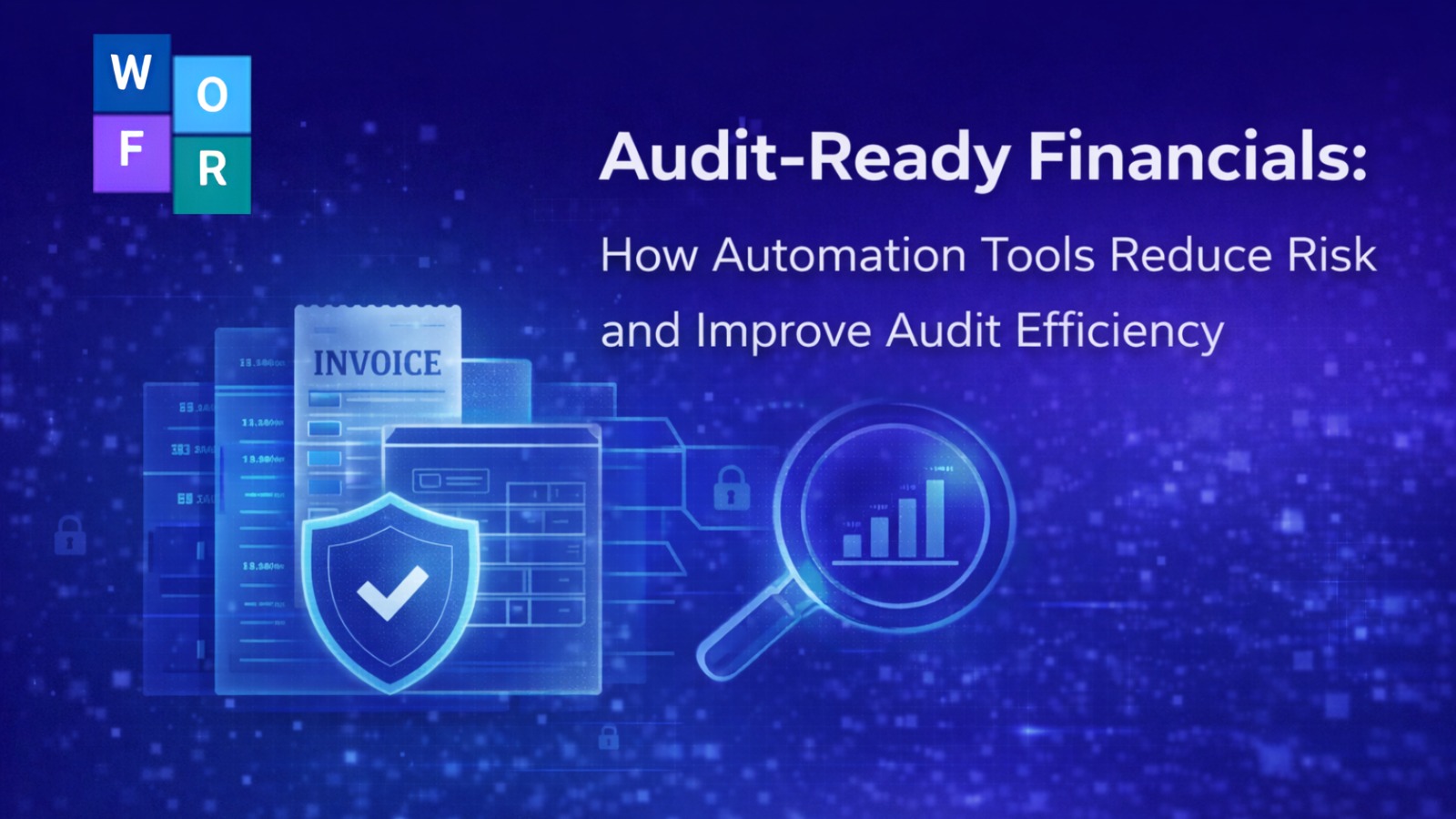
Audits are a test of confidence in your numbers, your controls, and your documentation. The good news? Automation tools are turning audits from a disruptive, time-consuming ritual into a predictable, efficient process. For finance teams, automation delivers three practical wins: fewer surprises, faster fieldwork, and stronger assurance that the numbers are right.
At WOFR, we combine technical accounting rigour with automation-first delivery. With experience across 200+ clients and over 100,000 hours of hard work, we’ve seen automation materially change the audit experience, not by papering over problems, but by exposing and fixing them earlier. Here’s how automation does it, and what finance leaders should do to capture the benefits.
Why automation matters for audit readiness
- Automation reduces risk in ways that are both obvious and subtle:
- It replaces brittle manual processes with repeatable, auditable workflows.
- It centralises and standardises data so auditors and management are looking at the same numbers.
- It enforces controls and documents evidence automatically, shortening the time auditors need to test balances.
- Put simply, automation turns reactive fire-fighting into proactive assurance!
The automation toolkit that moves the needle
Not every tool is equally impactful. The most audit-relevant automation falls into a few clear categories:
- Data integration and ETL: creates a single source of truth by pulling ERP, payroll, bank, lease and other feeds into a canonical data model.
- Reconciliation & close automation: automates bank, AR, AP and intercompany reconciliations and surfaces exceptions for owners to resolve.
- Lease and contract platforms: standardise IFRS 16/Ind AS 116 computations and capture key contract clauses automatically.
- RPA (Robotic Process Automation): handles repetitive tasks like bank statement imports, confirmation requests, and journal entry creation.
- BI and dashboarding: delivers real-time KPIs plus drill-through to transactional evidence.
- AI/ML tools: flag anomalies, predict control failures, and extract contract language for accounting treatment.
Each of these tools contributes to audit efficiency differently, and together, they reduce both the volume and the complexity of auditor testing.
How automation reduces audit risk with practical mechanisms
Single source of truth
Automated data pipelines standardise ledgers and currency conversions so every stakeholder, management, auditors & investors derive metrics from the same underlying dataset! That eliminates reconciliation disputes and reduces time spent reconciling differences.
Control-by-design
System-enforced workflows (for example, PO → GRN → Invoice matching) prevent errors from becoming journal adjustments. Controls are evidenced automatically, approvals, timestamps and attachments are stored and searchable.
Faster reconciliations and fewer manual adjustments
Automated reconciliations shrink the backlog of unreconciled items and enable cut-off testing earlier in the close cycle. That means auditors can sample a cleaner population and complete substantive procedures faster.
Transparent drill paths
Dashboards that allow drill-through to source documents remove “why is this different?” queries. Auditors spend less time chasing evidence and more time testing judgmental areas.
Predictive risk detection
AI models highlight unusual payments, revenue anomalies, or expense spikes, allowing teams to investigate before auditors raise the issue. Early remediation reduces the chance of material misstatement.
Consistent application of accounting policies
Encoding technical accounting rules in the data transformation layer ensures that revenue recognition, lease accounting, FX revaluations and impairments are calculated consistently across periods.
A practical roadmap to become audit-ready with automation
Start with an audit readiness assessment
Map your current controls, common auditor queries and the most time-consuming evidence requests. That tells you where automation gives the biggest ROI.
Prioritise high-impact automations
Begin with reconciliations, bank feeds, intercompany netting and contract ingestion for leases/revenue. These reduce the most frequent audit queries.
Embed accounting logic early
Put GAAP/IFRS/Ind AS rules in the ETL/transform layer, not in dashboards. This prevents “automating the error”.
Design controls into workflows
Automate approval gates, exception routing and SLA tracking. Make ownership visible and measurable.
Document everything and keep it live
Automated evidence is powerful only when it is discoverable. Version control your transformations, keep reconciliation snapshots, and index supporting documents.
Pilot, validate, scale
Pilot on one business unit or a single close cycle. Reconcile automated results with legacy numbers, capture user feedback, and iterate before scaling.
Change management and training
Automation changes roles, train auditors, controllers and transactional owners on new drill paths, exception workflows and responsibilities.
What finance leaders can expect – real benefits in real-time
While exact numbers vary, organisations that take a focused approach to automation typically see clear outcomes within months: shorter close cycles, fewer manual journal entries, reduced audit queries, and less rework during fieldwork. The real long-term benefit is cultural, a shift from “close and defend” to “close and explain” where finance becomes a provider of timely, reliable insight.
Where WOFR fits in
WOFR combines deep technical accounting expertise with practical automation and managed services. We help teams:
- Assess audit pain points and prioritise automation investments.
- Translate complex accounting standards into ETL logic and controlled workflows.
- Implement reconciliation engines, lease platforms and BI dashboards with drill-through.
- Operate or augment the finance function through Managed Services so governance and evidence collection run day to day.
- Our approach is pragmatic: automation is a means to reliable controls and timely decision-making, not a technology vanity project.
Automation transforms audits from high-effort checkpoints into efficient validation exercises. By centralising data, enforcing controls, and making evidence instantly available, finance teams can reduce audit risk and improve auditor efficiency. If your goal is audit-ready financials that scale with your business, start with the most painful manual tasks, embed accounting rules in the pipeline, and measure progress weekly.
If you’d like a practical starting point, WOFR offers an Audit Readiness Automation Assessment to identify quick wins and build a tailored roadmap. Contact us to schedule a discovery call and see a demo of audit-centric automation in action.